Our Hindu Rashtra: What It Is. How We Got Here by Aakar Patel
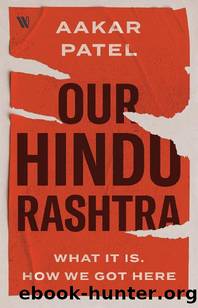
Author:Aakar Patel [Patel, Aakar]
Language: eng
Format: epub
Published: 2020-12-21T00:00:00+00:00
* * *
8. Chattisgarh was carved out of Madhya Pradesh in 2000 and hence had inherited its state-level laws.
9. The worry that Dalits and Adivasis would leave the Hindu fold was echoed also in Article 25, which gives the State the authority for âproviding for social welfare and reform or the throwing open of Hindu religious institutions of a public character to all classes and sections of Hindusâ. This is seen as creeping communalism. Academic Pritam Singh in his paper âHindu Bias in Indiaâs âSecularâ Constitution: Probing flaws in the instruments of governanceâ, (Third World Quarterly Vol. 26, No. 6) asked, âWhy should a secular state be concerned with social welfare and reform of only Hindu temples?â His response was that âit seems that the overriding concern behind these social reform measures was to prevent the exodus of the Dalits from the Hindu fold.â (quoted in âIs there a Hindu bias in Indiaâs secular Constitution?â, scroll.in, 2 February 2020). On the other hand, Hindu conservatives chafe at Article 25 for another of its provisions giving the State the right to regulate âeconomic, financial, political or other secular activity which may be associated with religious practiceâ. This is used to manage the large temple trusts such as Tirupathi, Siddhivinayak and Sabarimala. Some Hindus feel this is intrusion, though the BJP itself has not been concerned about this much. The issue has been mentioned in only one BJP manifesto, in 2009.
10. I am aware that âHarijanâ as a word is no longer acceptable to the Dalit community and the term âDalitâ is currently prevalent. However, in the instances where I am quoting old reports, studies and so on, I have thought it fit to retain the original usage and not alter it. I have myself used the word âDalitâ in the relevant contexts when commenting on the matters discussed.
11. The denial of entry to Dalits into temples occasionally breaks out in the national news. The Times of India (âAt Puri, priests block President Ram Nath Kovindâs way, shove First Ladyâ, 27 June 2018) reported how even the president of India was made unwelcome. Golwalkarâs solution of the Dalit hiding his identity to be able to secure entry would not apply in such an instance. Hindustan Times (âTemple entry ban angers Dalits in Orissa villageâ, 2 November 2006) reported hundreds of Dalits in Kendrapara threatening to convert over the issue. DNA (âDalit denied entry in temple: Orissa government steps in to resolve issueâ, 25 June 2011) reported Dalits facing a socio-economic boycott by the upper castes in Puri for wanting to enter a Kali temple. The chairman of the National Commission of Scheduled Castes, himself a Dalit and also a member of parliament, was himself denied entry when he went to investigate the matter. (âDalit MP denied entry in templeâ. News18, 25 June 2011). This happens regularly to Dalits but does not seem to produce the outrage that is should. The New Indian Express (âTwo priests booked for denying temple entry to Dalit girlâ, 17 January 2018) reported about an engineering student who was kept out of a Shiva temple.
Download
This site does not store any files on its server. We only index and link to content provided by other sites. Please contact the content providers to delete copyright contents if any and email us, we'll remove relevant links or contents immediately.
| Anthropology | Archaeology |
| Philosophy | Politics & Government |
| Social Sciences | Sociology |
| Women's Studies |
Born to Run: by Christopher McDougall(7125)
The Leavers by Lisa Ko(6948)
iGen by Jean M. Twenge(5415)
Sapiens by Yuval Noah Harari(5370)
Spare by Prince Harry The Duke of Sussex(5195)
The Kite Runner by Khaled Hosseini(5178)
Machine Learning at Scale with H2O by Gregory Keys | David Whiting(4313)
Bullshit Jobs by David Graeber(4190)
Never by Ken Follett(3954)
Goodbye Paradise(3810)
Livewired by David Eagleman(3772)
Fairy Tale by Stephen King(3394)
A Dictionary of Sociology by Unknown(3085)
Harry Potter 4 - Harry Potter and The Goblet of Fire by J.K.Rowling(3073)
The Social Psychology of Inequality by Unknown(3029)
The Club by A.L. Brooks(2925)
Will by Will Smith(2919)
0041152001443424520 .pdf by Unknown(2845)
People of the Earth: An Introduction to World Prehistory by Dr. Brian Fagan & Nadia Durrani(2736)
